Best Face Serum for Hyperpigmentation: CeraVe Leads

Seven discoloration serums, compared on the active ingredients their listings publish and the size of the bottle you actually get. CeraVe wins as the default, but three specific situations flip that recommendation to a different pick.

By Frankie HopkinsUpdated 18 min read
On this page
- Best face serum for hyperpigmentation at a glance
- How I screened these seven serums
- Which active ingredient actually decides it?
- 1. CeraVe Resurfacing Retinol Face Serum with Niacinamide — Best overall
- 2. Anua Niacinamide 10 + TXA 4 Serum — Best premium
- 3. Good Molecules Discoloration Correcting Serum — Runner-up
- 4. TruSkin Brightening Vitamin C Serum for Face — Best for beginners
- 5. medicube Kojic Acid Turmeric Clarifying Capsule Serum — Best for heavy use
- 6. Topicals, Faded Brightening Serum — Best for families
- 7. Minimalist 2% Alpha Arbutin with Hyaluronic Acid — Best budget pick
- Does bottle size matter more than concentration?
- Layering, irritation and the order of operations
- What the listings do not tell you about hyperpigmentation
- The verdict
- FAQ
The best face serum for hyperpigmentation is the CeraVe Resurfacing Retinol Face Serum, a 1 Fl Oz bottle pairing encapsulated retinol with niacinamide and licorice root extract. If your marks are flat and tonal rather than textural, the Anua Niacinamide 10 + TXA 4 Serum stacks three published actives in a 1.01 Fl Oz bottle instead. The deciding factor here is not brightness claims. It's which active class matches the kind of discoloration you actually have, and these seven serums split cleanly into three of them.
Best face serum for hyperpigmentation at a glance
| Pick | Key actives | Size | Price |
|---|---|---|---|
| Encapsulated retinol Niacinamide, licorice root |
1 Fl Oz | Check Price | |
Best premium Anua Niacinamide 10 + TXA 4 Serum |
10% niacinamide claim 4% tranexamic, 2% arbutin |
1.01 Fl Oz | Check Price |
| Tranexamic derivative Niacinamide |
1 Fl Oz | Check Price | |
Best for beginners TruSkin Brightening Vitamin C Serum |
Sodium ascorbyl phosphate Hyaluronic acid, vitamin E |
1 Fl Oz | Check Price |
Best for heavy use medicube Kojic Acid Turmeric Clarifying Capsule Serum |
Kojic acid, turmeric Niacinamide, squalane |
1.01 Fl Oz | Check Price |
Best for families Topicals, Faded Brightening Serum |
Azelaic acid Niacinamide |
0.5 Fl Oz | Check Price |
Best budget pick Minimalist 2% Alpha Arbutin with Hyaluronic Acid |
2% alpha arbutin claim Hyaluronic acid |
1 Fl Oz | Check Price |


How I screened these seven serums
I started from the serums listing in the Treatments & Masks > Serums category and worked from published data only: the active ingredients each brand names on its listing, the bottle size, the weight and the dimensions. Anything whose listing named no active at all got cut, because a serum that only promises "radiance" gives you nothing to compare.
What survived splits into three active classes. Four of the seven name a tyrosinase-pathway ingredient: arbutin in the Minimalist and Anua bottles, kojic acid in the medicube, tranexamic acid in the Good Molecules and Anua. Two lead with something else entirely. The CeraVe leads with encapsulated retinol, and the TruSkin leads with sodium ascorbyl phosphate, a stabilised vitamin C.
Six of the seven name niacinamide somewhere in their published ingredients. Only the Minimalist and the TruSkin skip it. That's worth noting because niacinamide is the shared backbone of this set rather than a differentiator.
A note on the search itself. Amazon's results for a hyperpigmentation query return general brightening serums alongside ones that name discoloration directly, and only the Minimalist listing uses the word hyperpigmentation in its own title. I have not claimed any of these seven treats a specific pigmentary condition. What I can tell you is which actives each one publishes, and you match that to what your skin is doing.
Which active ingredient actually decides it?
Most guides to the best face serum for hyperpigmentation compare percentages. That's the wrong axis. A 2% arbutin serum and a 10% niacinamide serum are not competing on strength, because they work on different steps of pigment production, and a higher number on the wrong step does nothing.
Here's the split that matters across these seven:
- Melanin-production blockers. Arbutin, kojic acid and tranexamic acid interfere with pigment being made. Best on flat, established discoloration: sun-driven patches, old marks, the kind that don't change texture under your fingertip. The Minimalist, Anua, medicube and Good Molecules serums all sit here.
- Cell-turnover accelerators. Retinol pushes pigmented cells up and out faster. Best where marks sit alongside rough or uneven texture, and it's the class with the highest irritation risk. Only the CeraVe belongs here.
- Antioxidant brighteners. Vitamin C works on oxidative damage and general dullness rather than a defined spot. The TruSkin is the only one in the set leading with it.
Then there's azelaic acid in the Topicals Faded, which straddles categories: its listing pairs it with niacinamide and frames it as anti-inflammatory as well as brightening.
The practical test is simple. Run a fingertip over a mark with your eyes closed. If you can feel it, you want turnover. If you only see it, you want a production blocker. That one check does more to narrow this field than any percentage on any box.
1. CeraVe Resurfacing Retinol Face Serum with Niacinamide — Best overall
The only serum here that combines a turnover active with barrier ingredients in one 1 Fl Oz bottle, which is why it's the safest default for post-acne marks.
Best for: post-acne marks on skin that also breaks out Skip it if: you're pregnant or already using a prescription retinoid
CeraVe's listing describes encapsulated retinol, meaning the active is carried in a delivery shell rather than sitting free in the formula. The stated intent is a gentler release. Alongside it the brand names niacinamide to calm skin and licorice root extract to brighten, plus three ceramides. That combination is what separates this from the rest of the set. Everything else here either blocks pigment or brightens, but nothing else addresses texture.
The bottle is 1 Fl Oz, 1.06 oz packed, in a 4.33 x 1.18 x 1.18 in body. It's the second-cheapest of the seven and it sells faster than five of them, so it's the most established formula in this comparison. The listing has been on the site since 2019, which for a skincare active is a long time without reformulation.
The trade-off is real. Retinol is the one class here that can make things worse before better, and it isn't compatible with pregnancy or with an existing prescription retinoid. If your marks are purely tonal, you're taking on irritation risk for a mechanism you don't need. Two sellers list it, so supply isn't a concern.
Pros:
- Encapsulated retinol for gentler release, per the listing
- Only pick here targeting texture and tone together
- Three ceramides plus niacinamide for barrier support
- Second-cheapest of the seven
- Fragrance-free, paraben-free and non-comedogenic per CeraVe
Cons:
- Retinol rules it out during pregnancy
- Purge phase is common with turnover actives
- No published concentration for the retinol
- Overkill if your discoloration is flat and tonal
2. Anua Niacinamide 10 + TXA 4 Serum — Best premium
Three named actives at three published percentages in one 1.01 Fl Oz bottle, which no other pick in this set matches.

Best for: layering three actives without buying three bottles Skip it if: you want the cheapest route to arbutin
Anua publishes 10% niacinamide, 4% tranexamic acid and 2% arbutin. That's the most transparent ingredient disclosure in this comparison, and it means you can compare it directly against single-active serums. Its 2% arbutin matches the Minimalist claim exactly, and it adds tranexamic acid on top, which the Good Molecules serum uses alone. Ceramides and hyaluronic acid round out the base per the listing.
At 1.01 Fl Oz it's marginally the largest volume here, tied with the medicube. It's the most expensive pick in the set. It's also the fastest-selling of the seven, edging out the CeraVe, which tells you the three-active stack resonates with buyers.
Two caveats. Only one seller lists it, the tightest supply in this group, so restocking may not be immediate. And the shipping weight is 5.29 oz against a 1.01 Fl Oz fill, meaning most of what you're carrying is glass and box. That's cosmetic rather than functional, but it's worth knowing if you travel. If arbutin alone is all you're after, the budget pick delivers the same 2% for the lowest price in the set.
Pros:
- Three actives with published percentages: 10%, 4%, 2%
- Largest volume here at 1.01 Fl Oz
- Ceramides and hyaluronic acid in the base
- Fragrance-free and free of artificial colouring per Anua
- The fastest seller of the seven
Cons:
- The most expensive pick in the set
- Only one seller lists it
- Heavy packaging relative to a 1.01 Fl Oz fill
- Three actives at once complicates isolating a reaction
3. Good Molecules Discoloration Correcting Serum — Runner-up
A stabilised tranexamic acid derivative paired with niacinamide, and the third-cheapest bottle here.

Best for: melasma-style patchy discoloration on sensitive skin Skip it if: your marks are textural as well as tonal
Good Molecules names cetyl tranexamate mesylate, a stabilised tranexamic acid derivative, working with niacinamide. Tranexamic acid is the active most associated with patchy, diffuse discoloration rather than isolated spots, which gives this bottle a narrower and clearer target than a general brightener. The listing calls it gentle enough for morning and night use and suitable for sensitive skin.
The bottle holds 1 Fl Oz in a 1.5 x 4.5 x 2 in package, 1.76 oz shipped. It's the third-cheapest of the seven. The listing directs you to apply a few drops after toner, follow with moisturiser and use SPF during the day, which is the only pick that spells out the sunscreen step explicitly.
Where it loses to the Anua is coverage. You get one pigment-pathway active where the premium pick gives you two plus a higher niacinamide claim. And it does nothing for texture, so if your marks feel raised or your skin is rough alongside the discoloration, the CeraVe is the better single purchase. It also publishes no concentration figure at all, which makes it hard to place against the numbered picks.
Pros:
- Stabilised tranexamic derivative, less common in this set
- Third-cheapest of the seven
- Approved for twice-daily use per the listing
- Cruelty-free, vegan and fragrance-free per Good Molecules
Cons:
- No published percentage for any active
- Single pigment-pathway active, unlike the Anua
- No texture benefit at all
- Slower selling than four other picks here
4. TruSkin Brightening Vitamin C Serum for Face — Best for beginners
The gentlest entry point in the set, using a stable vitamin C form rather than an acid or a retinoid.

Best for: a first brightening serum with no acid experience Skip it if: you've already plateaued on vitamin C
TruSkin specifies sodium ascorbyl phosphate rather than L-ascorbic acid, and names the reason directly: stability over time with less irritation than harsher vitamin C formulas. That's the appeal for anyone whose skin has never handled an active. The supporting cast is hydration-focused rather than brightening: hyaluronic acid, vitamin E, aloe vera and jojoba oil.
The 1 Fl Oz bottle is clear, weighs 28.3 g and measures 4 x 1.5 x 1.5 in, the most compact of the seven. It's the second-fastest seller in this set, behind only the Anua and the CeraVe. It sits in the higher price bracket here, which is the awkward part.
Vitamin C is the broadest and least targeted of the three classes in §Which active ingredient. It works on dullness and oxidative damage, so it earns its place as a starter serum and as a daytime layer under sunscreen. But if you've used vitamin C for months without your specific marks shifting, adding another one won't change the outcome. Move to a production blocker like the Good Molecules or the Anua instead. There's also no percentage published, so you can't judge potency.
Pros:
- Stable sodium ascorbyl phosphate, lower irritation per TruSkin
- Smallest footprint here at 4 x 1.5 x 1.5 in
- Hyaluronic acid, vitamin E and aloe in support
- Free from parabens and dyes, cruelty-free per the brand
Cons:
- Higher-priced than four picks with more targeted actives
- No published vitamin C concentration
- Broadest, least specific mechanism in the set
- No niacinamide, unlike five other picks
5. medicube Kojic Acid Turmeric Clarifying Capsule Serum — Best for heavy use
The only pick pairing kojic acid with turmeric, aimed squarely at marks that are still inflamed.
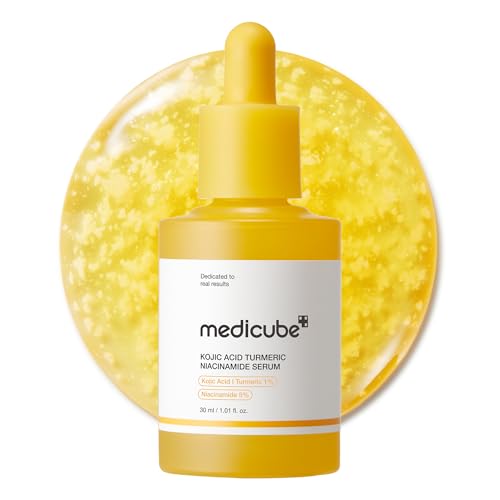
Best for: inflamed, still-healing breakout marks Skip it if: you dislike unpredictable textures
Kojic acid is a tyrosinase inhibitor and turmeric is described here as an antioxidant that soothes stressed skin. That pairing gives this serum a different job from the rest: it's positioned for use after spot care, when a blemish has cleared but the mark is fresh and the skin around it is still reactive. Niacinamide sits in the blend too.
The distinguishing format is the capsules. medicube describes snowflake-like micro-capsules that release squalane and thioctic acid on contact with skin, which is the only delivery-system claim in this set. It holds 1.01 Fl Oz, the joint-largest volume here, in a 4.09 x 1.77 x 1.89 in bottle weighing 1.06 oz. The listing carries a 2026 release date, making it the newest formula in the comparison.
Newness is also the drawback. There's no long track record behind this formula the way there is behind the 2019 CeraVe, and it sits in the higher price bracket while publishing no percentages for any of its actives. Capsule textures also feel gritty until they break down, which some people never warm to. If you want the same kojic-style pigment blocking without the texture, the Good Molecules or the Minimalist are simpler.
Pros:
- Only kojic acid and turmeric pairing in the set
- Joint-largest volume at 1.01 Fl Oz
- Capsules release squalane and thioctic acid per medicube
- Dermatologist-tested and suitable for delicate skin per the listing
Cons:
- Newest formula here, released 2026, with no track record
- Higher-priced with no published active percentages
- Capsule texture feels gritty on application
- Slower selling than four other picks
6. Topicals, Faded Brightening Serum — Best for families
The only azelaic acid formula here, in a 0.5 Fl Oz bottle designed to be used sparingly.

Best for: one small bottle shared as a targeted spot treatment Skip it if: you need full-face coverage twice a day
Azelaic acid is the outlier active in this comparison, and Topicals pairs it with niacinamide. The listing frames it around post-blemish marks, scars and uneven tone, and describes the formula as containing antioxidants and inflammation-reducing ingredients. It's dermatologist-tested per the brand.
The usage instruction is the honest part of this listing and the reason for the award. Topicals tells you to start at once a week and work up to daily, applying a thin layer to clean dry skin. That's a build-up protocol rather than an all-in serum, and it explains the 0.5 Fl Oz size: half the fill of every other pick here, 20 g on the scale. Used as directed, a small bottle stretches a long way, which suits a shared bathroom shelf where nobody needs a full-face dose.
The size is also the clear loss. If you're treating discoloration across both cheeks morning and night, 0.5 Fl Oz runs out roughly twice as fast as a 1 Fl Oz bottle at the same rate. It's the mid-priced pick, so you're paying a middling amount for the least product. No percentages are published either.
Pros:
- Only azelaic acid formula in this set
- Clear build-up protocol from weekly to daily
- Smallest, most portable fill at 20 g
- Dermatologist-tested per Topicals
Cons:
- Half the volume of five other picks at 0.5 Fl Oz
- Mid-priced for the least product in the set
- No published concentration for the azelaic acid
- Weekly start means slow progress at first
7. Minimalist 2% Alpha Arbutin with Hyaluronic Acid — Best budget pick
The cheapest of the seven and the only one whose own title names hyperpigmentation directly.

Best for: adding arbutin to a routine you already like Skip it if: you want one bottle to do everything
Minimalist publishes 2% alpha arbutin and describes it as a skin-lightening active it considers safer than kojic acid. That's the brand's framing rather than a verified comparison, but the useful part is the number. At 2% it matches the arbutin content Anua publishes, which is the most expensive pick here. You're getting the same stated arbutin percentage for the lowest price in the set, with hyaluronic acid alongside it.
The bottle is 1 Fl Oz, 28.3 g, in a 4.53 x 2.17 x 2.17 in package. The exclusion list is the longest of the seven: fragrance-free, silicone-free, sulfate-free, paraben-free, essential-oil-free and dye-free. For reactive skin that's a meaningful spec, because it removes six common irritant categories at once.
The catch is scope. This is a single-active add-on, not a complete serum. No niacinamide, no ceramides, no antioxidant support, and it's the slowest seller of the seven by a wide margin. Use it as a layer inside an existing routine and it does one job cheaply. Use it as your only treatment step and you'll notice how much the Anua and CeraVe are doing that it isn't.
Pros:
- Cheapest pick in the set
- Published 2% alpha arbutin, matching the premium pick
- Six ingredient categories excluded per the listing
- Hyaluronic acid included for hydration
Cons:
- Single active with no niacinamide or ceramides
- The slowest seller of the seven by a distance
- No texture or antioxidant benefit
- Works as an add-on rather than a standalone routine
Does bottle size matter more than concentration?
Often, yes. Discoloration serums are a months-long commitment, and a bottle that runs dry in three weeks costs you more than a weaker formula you can actually finish. Here's how the seven line up on fill.
- 1.01 Fl Oz: Anua, medicube. The joint-largest.
- 1 Fl Oz: CeraVe, Good Molecules, TruSkin, Minimalist. The standard.
- 0.5 Fl Oz: Topicals Faded. Half of everything else.
Shipping weights tell a second story. The Anua ships at 5.29 oz for a 1.01 Fl Oz fill, mostly glass and packaging. The Topicals is 20 g in total, the lightest thing here by a distance. If you're deciding what goes in a carry-on, that gap is the whole decision.
The concentration question only bites where percentages are published, and only two picks publish them: the Anua at 10/4/2 and the Minimalist at 2%. Everyone else names the active without the number. So for five of these seven you're choosing on ingredient class, not strength, and volume becomes the more useful lever.
One caveat on the Topicals size. Because its listing prescribes weekly-to-daily build-up rather than immediate twice-daily use, 0.5 Fl Oz isn't as short as it looks on paper. It's short if you ignore the instructions.
Layering, irritation and the order of operations
The fastest way to waste a good serum is to stack it on top of three others. Six of these seven contain niacinamide, so buying two of them means doubling an ingredient you already had enough of.
A workable order:
- Cleanse and dry the skin. The Topicals listing specifies clean, dry skin for a reason: damp application spreads a targeted treatment where you didn't want it.
- Apply one treatment serum, a few drops for the Good Molecules, one to two for the Anua.
- Wait for absorption. Anua's own instruction is to allow full absorption before moisturiser.
- Moisturise.
- Sunscreen every morning without exception. Good Molecules is the only listing here that says so outright, and it's the single most important line in this entire guide.
That last point deserves emphasis. Every mechanism represented in this set works against new pigment formation or clears existing pigment, and unprotected sun exposure works in the opposite direction faster than any serum works in yours. Skipping SPF while using a brightening serum is running a bath with the plug out.
If you're pairing two products, pick from different classes. The CeraVe retinol at night and the TruSkin vitamin C in the morning is a sensible split. Two production blockers on top of each other is not.
What the listings do not tell you about hyperpigmentation
Amazon's search for the best face serum for hyperpigmentation returns brightening serums broadly, and only one of these seven, the Minimalist, uses that word in its own product title. So a straight answer: I can tell you what actives each brand publishes and how much product is in the bottle. I cannot tell you which of these treats a specific pigmentary condition, because none of these listings makes that kind of claim and I'm not going to invent one.
Three gaps in the published data worth knowing about:
- No percentages on five of seven. CeraVe doesn't state how much retinol. TruSkin doesn't state how much vitamin C. Topicals doesn't state how much azelaic acid. You're buying an ingredient list, not a dose.
- No pH values anywhere. For acid-based actives, pH affects behaviour. Not one listing publishes it.
- No timeframes. Several listings say "with continued use" without defining continued. Pigment turnover is slow, and any serum you judge after ten days you've judged too early.
The other thing to know is when a serum isn't the answer. Deep dermal pigmentation, hormonally driven melasma and anything changing shape or colour belong with a professional, not a bottle from a shelf. A serum works on the pigment that's near the surface and on the pigment that hasn't formed yet.
The verdict
If you have post-acne marks and skin that still breaks out, the CeraVe Resurfacing Retinol Face Serum is your pick. It's the only serum here working on cell turnover, so it's the only one addressing rough texture and dark marks in a single 1 Fl Oz bottle, and the encapsulated retinol plus three ceramides is a combination designed to soften the irritation that normally comes with the class. Second-cheapest of the seven, on the site since 2019, and faster-selling than five of the others.
If your discoloration is flat and tonal, with nothing to feel under a fingertip, the Anua Niacinamide 10 + TXA 4 Serum wins instead. Its exact advantage is disclosure: 10% niacinamide, 4% tranexamic acid and 2% arbutin, three published numbers where five of these seven publish none. Two pigment-pathway actives in one 1.01 Fl Oz bottle, and the fastest seller in this set.
The cutoff is the fingertip test. Texture you can feel means turnover, and that means the CeraVe. Tone you can only see means production blocking, and that means the Anua. Two adjustments to that rule: if you're pregnant or on a prescription retinoid, retinol is out and the Good Molecules serum takes over as the default. If you've never used an active before, start with the TruSkin and graduate later.
FAQ
Is the best face serum for hyperpigmentation always the most expensive one?
The best face serum for hyperpigmentation isn't the priciest bottle here. Our overall winner, the CeraVe, is the second-cheapest of the seven. The Minimalist is cheapest and publishes the same 2% alpha arbutin as the most expensive pick. What extra money buys is more actives in one bottle, not a stronger version of the same thing.
Is a dark spot serum worth it if I already use sunscreen?
A dark spot serum is worth it alongside sunscreen, not instead of it. Sunscreen prevents new pigment from forming. A serum works on the pigment already there, through blocking production or accelerating turnover. Using one without the other is the common mistake, and Good Molecules is the only listing in this set that names the SPF step explicitly.
How much serum do I actually get in each bottle?
You get 1 Fl Oz in the CeraVe, Good Molecules, TruSkin and Minimalist bottles, and 1.01 Fl Oz in the Anua and medicube. The Topicals Faded is the exception at 0.5 Fl Oz, half the fill of the rest. Its listing prescribes weekly build-up to daily use, so it stretches further than the number suggests.
CeraVe or Anua: which face serum for hyperpigmentation should I pick?
Between CeraVe and Anua for hyperpigmentation, the choice is texture versus tone. CeraVe's encapsulated retinol accelerates cell turnover, so it addresses marks that feel raised or rough. Anua's 10% niacinamide, 4% tranexamic acid and 2% arbutin block pigment production, better for flat discoloration. CeraVe also costs less; Anua publishes more numbers.
What's the biggest mistake people make with brightening serums?
The biggest mistake is stacking overlapping actives. Six of these seven serums contain niacinamide, so buying two of them doubles an ingredient rather than adding a new mechanism. The second mistake is judging results in under a month. Pigment turnover is slow, and every listing here that mentions timing says "with continued use" for a reason.
Start with the fingertip test on your worst mark, then buy the one serum that matches what you find. One bottle, one mechanism, three months, and sunscreen every single morning. The CeraVe is the right default because it covers both axes at once: pigmented marks and the uneven texture that usually arrives with them, in the second-cheapest bottle of the seven. If retinol is off the table for you, the Good Molecules serum takes that slot without the irritation risk. What you should not do is buy three of these and layer them, which is the fastest route to an irritated barrier and no visible progress at all.