Best Face Serum for Dark Circles by Ingredient

Six serums, three ingredient strategies, one clear winner for pigmented shadows and one for puffy morning eyes. Here's how to match a serum to what's actually causing the darkness under your eyes.

By Frankie HopkinsUpdated 17 min read
On this page
- Best face serum for dark circles at a glance
- What's actually causing the shadow under your eye?
- Why an eye serum beats a face serum here
- How I screened the shortlist
- 1. The Ordinary Caffeine Solution 5% + EGCG Eye Serum — Best overall
- 2. The Ordinary Multi-Peptide Eye Serum — Best premium
- 3. USMOTAR Retinol & Caffeine Eye Serum — Best upgrade
- 4. Eclat Skincare Vitamin C Serum — Most versatile
- 5. TruSkin Vitamin C Serum — Best minimal setup
- 6. Florence Vitamin C Serum — Best for pros
- Caffeine, retinol or vitamin C: which one for you?
- How long before you see anything?
- What the listings do not tell you
- The verdict
- FAQ
The best face serum for dark circles is The Ordinary Caffeine Solution 5% + EGCG Eye Serum, a 1 fl oz water-based formula built around caffeine and EGCG for the puffy, shadowed look that comes from tired eyes. If your circles are really fine lines and creping catching the light, The Ordinary Multi-Peptide Eye Serum at 0.5 fl oz is the better call. Most buyers compare vitamin C percentages. That's not what decides this category.
Best face serum for dark circles at a glance
| Pick | Size | Key actives | Price |
|---|---|---|---|
| 1 fl oz | Caffeine 5%, EGCG, hyaluronic acid | Check Price | |
Best premium The Ordinary Multi-Peptide Eye Serum |
0.5 fl oz | Matrixyl synthe'6, SYN-AKE, niacinamide (claim) | Check Price |
Best upgrade USMOTAR Retinol & Caffeine Eye Serum |
1.35 fl oz | Retinol, caffeine, hyaluronic acid (claim) | Check Price |
Most versatile Eclat Skincare Vitamin C Serum |
1 fl oz | 3-O Ethyl Ascorbic Acid, hyaluronic acid (claim) | Check Price |
Best minimal setup TruSkin Vitamin C Serum |
1 fl oz | Sodium Ascorbyl Phosphate, hyaluronic acid (claim) | Check Price |
Best for pros Florence Vitamin C Serum |
2 fl oz | Vitamin C, niacinamide, hyaluronic acid (claim) | Check Price |


What's actually causing the shadow under your eye?
Dark circles aren't one problem. They're four, and each one needs a different serum. Sort yours before you buy, because a caffeine serum aimed at pigmentation is a waste of a bottle.
- Vascular shadow. Blueish or purple, worse when you're tired. Thin skin lets underlying vessels show through. Caffeine constricts vessels temporarily and reduces the shadow.
- Puffiness casting a shadow. The bag itself isn't dark, but it throws a shadow onto the cheek below. Caffeine and cool application help.
- Pigmentation. Genuine brown or tan colour in the skin. Common in medium-to-deep skin tones. Vitamin C and niacinamide slowly fade it.
- Structural hollowing. A tear trough deepens with age and casts a shadow. Serums do very little here. Peptides and retinol help firmness at the edges, but this is fundamentally an anatomy issue.
Look in a mirror in flat morning light. Stretch the skin gently sideways. If the colour stays put, it's pigmentation. If it fades, it's shadow.
That single check decides whether the best face serum for dark circles for you is caffeine-led, vitamin C-led or peptide-led. This roundup covers all three routes.
Why an eye serum beats a face serum here
Three of these six are eye-contour products. Three are full-face vitamin C serums that a listing mentions in connection with dark spots. Both can help, but not equally.
The eye-area picks — The Ordinary Caffeine Solution 5% + EGCG, The Ordinary Multi-Peptide Eye Serum, and USMOTAR Retinol & Caffeine Eye Serum — are formulated for thin, reactive skin. Two of the six list Eyes as their category path. One is filed under Eyes > Serums specifically. Sizes reflect this: the Caffeine Solution is 1 fl oz, the Multi-Peptide is 0.5 fl oz, and the USMOTAR is 1.35 fl oz. Small bottles, targeted use.
The three vitamin C serums — Eclat, TruSkin and Florence — are sized for the whole face. Florence is 2 fl oz, twice the volume of the Caffeine Solution. TruSkin and Eclat are 1 fl oz each. All three sit under Treatments & Masks > Serums, not Eyes.
A face serum for dark circles has to be gentle enough for the eye area or you'll get stinging and irritation that makes the circles look worse. That's the trap. The vitamin C picks are useful for pigmentation across the whole face, and the eye area comes along for the ride. The eye serums are targeted at the shadow, the puff and the fine lines that live there.
How I screened the shortlist
I compared the published specifications side by side, then read every feature bullet the brands supplied. The keyword here is "face serum for dark circles", and Amazon's results mix two product types under it: dedicated eye serums and full-face vitamin C serums that mention dark spots. Both routes are legitimate, so both are represented.
- Kept: products that name dark circles, brightening, dark spots or the eye area in their listing.
- Cut on principle: anything without a size figure. All six here publish one.
- Cut on overlap: near-duplicate vitamin C serums with weaker ingredient disclosure than TruSkin or Eclat.
- Cut on relevance: general anti-aging serums that don't mention pigmentation or the eye area at all.
Ingredient forms matter more than percentages, especially for vitamin C. TruSkin and Eclat both use Sodium Ascorbyl Phosphate or 3-O Ethyl Ascorbic Acid rather than pure ascorbic acid — stable derivatives that the brands say are gentler. Whether the difference matters to your skin depends on how it reacts, and no listing can tell you that.
One product is 2 fl oz (Florence). One is 1.35 fl oz (USMOTAR). Three are 1 fl oz. One is 0.5 fl oz (Multi-Peptide). That's a 4x spread in bottle size across a set of six, which matters for how long a bottle actually lasts.
1. The Ordinary Caffeine Solution 5% + EGCG Eye Serum — Best overall
A 1 fl oz water-based eye serum with 5% caffeine, aimed squarely at the puffy, tired-eye version of dark circles.
Best for: puffy, tired-looking eyes with a bluish tint from poor sleep Skip it if: your circles are brown pigmentation rather than shadow
This is the best face serum for dark circles for the most common cause: vascular shadow and puffiness. The listing puts caffeine at 5%, paired with EGCG (Epigallocatechin Gallatyl Glucoside), a green-tea-derived antioxidant. The Ordinary says the formula visibly reduces puffiness and the look of dark circles, and that it's water-based and suitable for morning and night use.
Two things separate it from everything else in this set. First, it's the cheapest of the six. Second, it's the one buyers choose most often here by a wide margin. Its category rank is far ahead of the others in the same eye-care aisle. Combine the size (1 fl oz), the price position and the direct caffeine-plus-antioxidant approach and it's the obvious default.
The dimensions are compact at 4.5 x 1.31 x 1.31 in, so it fits a travel bag easily. The main trade-off: it's water-thin. If you like a rich cream around your eyes, this will feel like almost nothing. And if your dark circles are pigmentation rather than shadow, caffeine doesn't touch them.
Pros:
- Caffeine 5% plus EGCG named on the listing
- Cheapest option in the set
- Compact 4.5 in bottle for travel
- Water-based, suitable morning and night per brand
- Hydration support via hyaluronic acid and soybean seed extract
Cons:
- Water-thin texture won't suit fans of rich eye creams
- Doesn't address pigmentation-type dark circles
- No dropper or airless pump specified
2. The Ordinary Multi-Peptide Eye Serum — Best premium
A 0.5 fl oz peptide-loaded eye serum for when the darkness comes with visible fine lines and crow's feet.

Best for: crow's feet and creping alongside the dark circle Skip it if: you want a larger bottle for the price position
This is the most expensive pick here, and it's the smallest at 0.5 fl oz. What you're paying for is the peptide stack. The Ordinary lists Matrixyl synthe'6, RetinoPeptide 189, SYN-AKE, CYTOBIOL LUMIN-EYE, UNISOOTH EG-28 and Eyeseryl on the label, alongside niacinamide and EGCG. That's six named peptide or peptide-adjacent actives in one bottle.
Where the Caffeine Solution above works on the shadow, this one works on the texture that catches shadow. Crow's feet, fine lines and creping under the eye all darken the area by scattering light. Peptides support the appearance of firmness in that skin. The listing also mentions reducing the look of dark circles and improving luminosity, so it plays double duty.
The 3.66 x 1.05 x 1.05 in bottle is tiny — you'll notice how little product you're getting relative to the 1 fl oz eye serums. That's the honest trade-off: highest price position in the set, smallest bottle. It earns its slot if fine lines are half your dark-circle problem. If they're not, the Caffeine Solution is cheaper and more directly useful.
Pros:
- Six named peptide-type actives per the listing
- Also contains niacinamide for tone
- Compact clear bottle for a bathroom shelf
- Suitable morning and evening per brand
- Targets crow's feet as well as shadow
Cons:
- Half the size of the Caffeine Solution
- Highest price position in this set
- Peptide claims are the manufacturer's, not measured here
3. USMOTAR Retinol & Caffeine Eye Serum — Best upgrade
A 1.35 fl oz eye serum that stacks retinol on top of caffeine, dispensed through an airless pump.

Best for: combining retinol renewal with caffeine depuffing in one step Skip it if: you're new to retinol and want a fully published spec sheet
If you like the idea of the Caffeine Solution but also want retinol working alongside it, this is the shortcut. USMOTAR says the formula uses stabilised retinol, caffeine and hyaluronic acid, and dispenses through an airless pump — a useful detail because retinol degrades on exposure to air and light. The bottle is 1.35 fl oz, the largest of the eye-focused picks here.
The retinol angle matters. Caffeine handles today's puffiness. Retinol works over weeks to thicken the thin skin under the eye, which reduces how much of the underlying vessel colour shows through. Two mechanisms, one bottle. The USMOTAR listing frames it as beginner-friendly and mentions sensitive skin, though retinol always warrants a slow introduction.
The trade-off is transparency. USMOTAR publishes fewer specifications than either of The Ordinary picks. There's no weight, no dimensions and no model number in the listing data — just the size and the count. You're trusting the ingredient names on the front of the bottle more than a full published spec sheet. For the second-cheapest position in the set, that's a reasonable trade if you want the retinol-plus-caffeine combination.
Pros:
- Retinol and caffeine in one formula per the listing
- Airless pump dispenser cited by the brand
- Largest bottle among the eye-focused picks at 1.35 fl oz
- Second-cheapest of the six
- Adds hyaluronic acid for hydration per the listing
Cons:
- Fewer published specifications than either Ordinary pick
- Retinol needs slow introduction on eye-area skin
- Only two sellers list it
4. Eclat Skincare Vitamin C Serum — Most versatile
A 1 fl oz vitamin C serum for face-wide brightening, with dark spots and uneven tone in its brief.
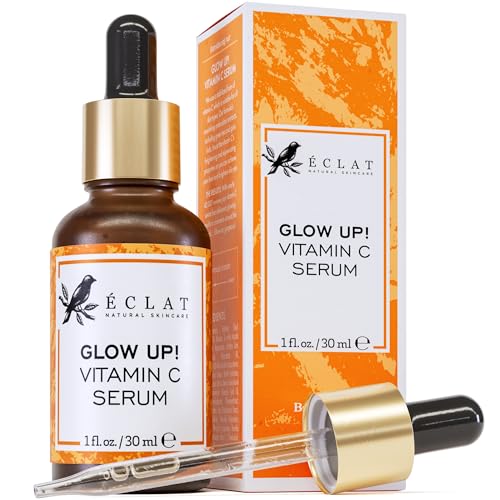
Best for: pigmentation on cheeks, dark spots and under-eye dullness together Skip it if: you need something formulated specifically for the eye contour
If the mirror test in the first section pointed to pigmentation rather than shadow, this is where you look. Eclat's formula uses 3-O Ethyl Ascorbic Acid, a stable vitamin C derivative that the brand says is more nourishing than the ascorbic acid used by leading rivals. The listing adds hyaluronic acid, ferulic acid, vitamin E and aloe. Sits under Treatments & Masks > Serums, not Eyes.
That last point matters. Eclat isn't formulated specifically for the thin skin under the eye — it's a face serum with brightening claims that extend to that area. Patch test before you go anywhere near your eye contour. Applied to the cheek, under-eye area (carefully) and elsewhere, it addresses pigmentation as a whole-face project rather than an eye-only one.
Compared to TruSkin below, it sits at the mid price position rather than premium, and the brand makes a more specific claim about its vitamin C form. Compared to Florence, it's half the size but names its ingredient more precisely. The trade-off against the eye serums is real: for pure shadow or puffiness, caffeine still wins.
Pros:
- 3-O Ethyl Ascorbic Acid named as the vitamin C form
- Mid price position, not premium
- Full-face use for pigmentation and dark spots
- Adds ferulic acid, vitamin E and aloe per the listing
- Vegan and cruelty-free per the brand
Cons:
- Not formulated specifically for eye-area skin
- Won't help vascular shadow the way caffeine does
- Warranty field is used for marketing copy, not warranty terms
5. TruSkin Vitamin C Serum — Best minimal setup
A 1 fl oz vitamin C serum built around Sodium Ascorbyl Phosphate, aimed at a simple one-step brightening routine.

Best for: a single brightening step that works across the whole face Skip it if: your main concern is puffiness rather than tone
TruSkin sells this as a straightforward brightening serum, and simplicity is the appeal. It uses Sodium Ascorbyl Phosphate — a stable vitamin C derivative the brand says helps minimise irritation compared to harsher vitamin C forms. The 1 fl oz bottle is clear, the dimensions are 4 x 1.5 x 1.5 in, and the listing adds hyaluronic acid, vitamin E, aloe vera and jojoba oil.
This is the second-most-popular pick in the set by category rank, behind only the Caffeine Solution. It sits at the premium price position of the six, which is worth noting: you're paying more than Eclat for what looks like a similarly gentle vitamin C derivative approach. What TruSkin adds is a cleaner ingredient story — the listing calls out being free from parabens, dyes and harsh additives, and unscented.
For the best face serum for dark circles when your issue is pigmentation, this is a defensible pick if you value simplicity and gentleness. The honest trade-off: it's the most expensive vitamin C option here, and it does nothing directly for puffiness or vascular shadow. Pair it with a caffeine eye serum if you have both.
Pros:
- Sodium Ascorbyl Phosphate named as the vitamin C form
- Unscented, free from parabens and dyes per the brand
- Simple one-step brightening application
- Compact 4 in bottle
- Made in the USA per the listing
Cons:
- Premium price position among vitamin C picks
- No caffeine or peptide component
- Not formulated specifically for the eye contour
6. Florence Vitamin C Serum — Best for pros
A 2 fl oz face, neck and eye-area vitamin C serum with the biggest bottle in the roundup.

Best for: layering across face, neck and eye area in one bottle Skip it if: you keep your routine to eye-area products only
Florence is the outlier on size. At 2 fl oz, it's double the volume of Eclat and TruSkin, and four times the Multi-Peptide Eye Serum. The brand explicitly recommends applying it to face, neck and eye area, so it's positioned as a multi-tasker for someone who wants one bottle rather than three. The listing names vitamin C, low- and medium-molecular-weight hyaluronic acid, niacinamide, vitamin E, jojoba oil and aloe.
Niacinamide is the useful addition against pigmentation-type dark circles specifically — it's one of the better-studied ingredients for uneven tone. Florence pairs it with vitamin C and calls the serum dermatologist tested on all skin types and tones.
Where it slots into this ranking: mid price position but the largest bottle by volume. Per fluid ounce, that's aggressive pricing. The trade-offs are that Florence doesn't name its specific vitamin C form as clearly as Eclat or TruSkin, and it's built as a whole-face serum rather than a targeted eye-area product. If you're already running a full routine and want one bottle that touches everywhere, that's a feature, not a flaw.
Pros:
- Largest bottle in the set at 2 fl oz
- Niacinamide named alongside vitamin C
- Formulated for face, neck and eye area per the brand
- Low- and medium-molecular-weight hyaluronic acid claimed
- Dermatologist tested per the listing
Cons:
- Doesn't name the specific vitamin C form as precisely as Eclat or TruSkin
- Larger 5.12 x 3.15 in footprint on a shelf
- General face serum rather than eye-area targeted
Caffeine, retinol or vitamin C: which one for you?
Three ingredient routes, three different jobs. Match the route to the cause of your circles.
- Caffeine shrinks vessels temporarily and reduces the blue shadow. Fast results, needs daily use to hold. The Ordinary Caffeine Solution 5% + EGCG is the direct pick here.
- Retinol works over weeks. It thickens the thin under-eye skin and reduces how much vessel colour shows through. Slow starter. USMOTAR pairs it with caffeine so you get both timelines.
- Vitamin C and niacinamide fade pigmentation slowly. Weeks to months of consistent use. Eclat, TruSkin and Florence all take this route.
- Peptides support the appearance of firmness at the tear trough edge. Multi-Peptide is the peptide-heavy pick.
Two more shortcuts worth knowing:
- Cool the applicator or store it in the fridge if puffiness is your main issue. It amplifies the vessel-constriction effect.
- Sunscreen every day matters more for pigmentation-type circles than any serum will. UV keeps making the darkness that vitamin C is trying to fade.
The best face serum for dark circles isn't a universal answer — it's the one that matches what's actually casting the shadow.
How long before you see anything?
Expectations decide whether you stick with a serum long enough for it to work. Here's the honest timeline by ingredient, drawn from how each of these formulas is designed to act.
- Caffeine (Ordinary Caffeine Solution, USMOTAR): minutes to hours for depuffing. The visible reduction in shadow is same-day. Stops working when you stop applying.
- Peptides (Multi-Peptide): four to eight weeks for texture changes. Fine lines soften gradually.
- Retinol (USMOTAR): six to twelve weeks. Skin renewal is slow, and eye-area skin needs a gentle build-up.
- Vitamin C (Eclat, TruSkin, Florence): four to twelve weeks for pigmentation fading. Consistency beats concentration.
If you stop after two weeks because "nothing happened", you stopped too early for anything except caffeine. Give a bottle a full six weeks of daily use before you judge.
What the listings do not tell you
A few gaps worth knowing before you buy.
- Percentages beyond caffeine. Only The Ordinary publishes the caffeine percentage (5%). None of the vitamin C listings publish their vitamin C percentage, only the form.
- Fragrance status. Only TruSkin explicitly says unscented. The others don't specify.
- Warranty and returns. Only one product has a Warranty field populated, and that field contains marketing copy rather than warranty terms. Treat all six as covered by Amazon's standard returns, not a brand warranty.
- Applicator type. USMOTAR specifies an airless pump. The others don't confirm dropper versus pump in their spec data.
- Compatibility with actives you already use. No listing tells you whether it plays well with the retinol or acid you might already be running.
These aren't dealbreakers. They're reasons to check the product page directly for anything critical to your routine before you buy.
The verdict
The Ordinary Caffeine Solution 5% + EGCG Eye Serum is the best face serum for dark circles for the most common cause of the problem: shadow and puffiness from tired eyes. It's the cheapest pick in the set, the one buyers reach for most often here, and it names both its key active (5% caffeine) and its supporting one (EGCG) directly on the label. The 1 fl oz bottle is compact enough for travel, the water-based texture suits morning and night use, and the brand is a known quantity.
Two clear flips. If fine lines and creping are half of what makes your under-eye look dark, The Ordinary Multi-Peptide Eye Serum is the better call — it names six peptide-type actives and specifically targets crow's feet alongside dark circles, at the cost of half the volume and the highest price position here. If your circles are pigmentation (they stay put when you stretch the skin), skip the eye serums and start with a vitamin C: Eclat if you want the most transparent ingredient story at a mid price position, TruSkin if you want the simplest formula, Florence if you want to cover face, neck and eye area from one bottle. USMOTAR is the bridge pick, layering retinol on top of caffeine for people who want both timelines in one product.
FAQ
Can a face serum for dark circles actually work on pigmentation?
A face serum for dark circles can help pigmentation slowly, over four to twelve weeks of consistent use. Vitamin C derivatives like Sodium Ascorbyl Phosphate (in TruSkin) and 3-O Ethyl Ascorbic Acid (in Eclat), plus niacinamide (in Florence and the Multi-Peptide), gradually fade excess melanin. Daily sunscreen matters more than the serum choice — without it, the pigmentation keeps refreshing.
Is The Ordinary Caffeine Solution worth it compared to premium eye creams?
The Ordinary Caffeine Solution is worth it if your dark circles are shadow-and-puffiness rather than pigmentation or deep lines. It's the cheapest of the six picks here, publishes its 5% caffeine content directly, and pairs that with EGCG in a 1 fl oz bottle. For fine lines and creping, the Multi-Peptide Eye Serum from the same brand is a better fit despite the higher price position.
What size bottle should I expect from a good under-eye serum?
Under-eye serums range from 0.5 fl oz to 1.35 fl oz in this set. The Multi-Peptide Eye Serum is 0.5 fl oz, the Caffeine Solution is 1 fl oz, and USMOTAR is 1.35 fl oz. A little goes a long way around the eye — a pea-sized amount per application is standard — so even the smallest bottle lasts weeks with daily use.
The Ordinary Caffeine Solution versus USMOTAR Retinol & Caffeine — which one?
The Ordinary Caffeine Solution wins if you want the simplest, cheapest route to depuffing and shadow reduction, with 5% caffeine and EGCG in a well-known formula. USMOTAR wins if you want retinol working alongside caffeine for longer-term skin renewal, and you're comfortable with retinol on eye-area skin. USMOTAR also adds an airless pump. USMOTAR publishes fewer specifications, which is the trade-off.
What mistake do people make buying a face serum for dark circles?
The mistake buying face serum for dark circles is picking by trend rather than cause. Vitamin C is popular but useless for vascular shadow. Caffeine is quick but does nothing for pigmentation. Retinol needs weeks. Do the mirror-stretch test in flat light first: if the colour fades when you pull the skin sideways, it's shadow and caffeine is your route. If it stays, it's pigmentation.
Once you know which of the four causes is behind your circles, the shortlist collapses to one or two products. Start with the mirror check, then pick the ingredient route that matches. If you're not sure, the Caffeine Solution is the lowest-risk starting point — it's cheap enough to try, targets the most common cause, and won't irritate eye-area skin the way a stronger vitamin C or retinol might. Give any serum a full six weeks of daily morning and evening use before you decide it isn't working. Then, and only then, escalate to the peptide or retinol route.