Best Niacinamide Face Serum for Dark Spots: Ordinary Wins

Five niacinamide serums compared for dark-spot use. One wins on price and reach, one wins on formula, and the split between them is smaller than the marketing suggests.

By Frankie HopkinsUpdated 16 min read
On this page
- Best niacinamide face serum for dark spots at a glance
- What buyers compare that does not decide it
- How I narrowed 40-plus listings to five
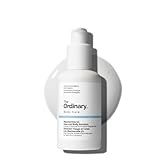
- 1. The Ordinary Niacinamide 10% + Zinc 1% — Best overall
- 2. Naturium Niacinamide Serum 12% Plus Zinc 2% — Best upgrade
- 3. The Ordinary Niacinamide 5% Face and Body Emulsion — Most versatile
- 4. Anua Niacinamide 10 + TXA 4 Serum — Best minimal setup
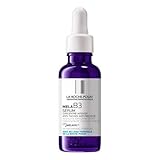
- 5. La Roche-Posay Mela B3 Dark Spot Face Serum — Best premium
- Does niacinamide actually fade dark spots?
- How the five formulas stack up on paper
- What to layer with your serum
- Which pick fits which routine?
- The verdict
- FAQ
The best niacinamide face serum for dark spots is The Ordinary Niacinamide 10% + Zinc 1%, a 1 fl oz clear serum that pairs the working concentration with the lowest price position in this set. If your marks are stubborn and you want a formula built specifically around discoloration, La Roche-Posay Mela B3 with 10% niacinamide and the brand's Melasyl complex is the better buy. Five serums, one straightforward decision once you know what the percentage on the label actually does.
Best niacinamide face serum for dark spots at a glance
| Pick | Niacinamide % | Size | Price |
|---|---|---|---|
Best overall The Ordinary Niacinamide 10% + Zinc 1% |
10% + 1% zinc PCA | 1 fl oz | Check Price |
Best upgrade Naturium Niacinamide Serum 12% Plus Zinc 2% |
12% + 2% zinc PCA | 1 fl oz | Check Price |
Most versatile The Ordinary Niacinamide 5% Face and Body Emulsion |
5% (face + body) | 3.4 fl oz | Check Price |
Best minimal setup Anua Niacinamide 10 + TXA 4 Serum |
10% + 4% tranexamic acid + 2% arbutin (claim) |
1.01 fl oz | Check Price |
Best premium La Roche-Posay Mela B3 Dark Spot Face Serum |
10% + Melasyl (claim) | 1 fl oz | Check Price |



What buyers compare that does not decide it
Most shoppers pick a niacinamide face serum by the percentage on the front of the bottle. That is the wrong tie-breaker. Once you clear 5% niacinamide, the returns on going higher flatten out, and the practical differences across these five are about what else is in the bottle, how much serum you get, and whether the formula is aimed at dark spots specifically or at general skin tone.
Consider the range in this set. The Ordinary Niacinamide 10% + Zinc 1% and La Roche-Posay Mela B3 both sit at 10% niacinamide. Naturium pushes to 12% with 2% zinc PCA. The Ordinary's newer 5% emulsion drops the percentage and expands the coverage to face and body across 3.4 fl oz. Anua stacks 10% niacinamide with 4% tranexamic acid and 2% arbutin, ingredients that target pigment through a different pathway. A reader comparing only the niacinamide number would rank these five in an order that says almost nothing about how each performs on discoloration.
A note on the "for dark spots" search. Niacinamide is a supporting ingredient for pigmentation rather than a primary treatment like hydroquinone or a prescription retinoid. Of the five picks here, only two describe themselves on-listing as dark-spot correctors. The rest are general-purpose niacinamide serums that may help even skin tone as part of a broader routine. Read the pick sections with that in mind.
How I narrowed 40-plus listings to five
I set three cutoffs and every serum in the roundup had to clear all three.
- A niacinamide percentage stated on the listing. "Contains niacinamide" without a figure does not tell you whether you are buying 2% or 10%. Every pick here publishes the exact concentration.
- A face-serum format sold in a bottle you can dose in drops. Wash-offs, sheet masks and moisturisers with niacinamide were cut. Serums layer under whatever you are already using; a moisturiser forces you to swap out the one you like.
- Available from more than a single, obscure seller where possible. Four of the five have two sellers listed. Anua is stocked by one, which is worth knowing before you commit.
That left the five you see. The Ordinary Niacinamide 10% + Zinc 1% is the standout on distribution: its sales rank of 31 in serums is the lowest number in the set by a wide margin, which is the plainest signal available that this is the reference product people reach for first. It is also the cheapest of the five. That combination is the reason it takes the top spot even though La Roche-Posay's Mela B3 is arguably the more sophisticated dark-spot formula.
Three names I expected to see were cut for missing percentage disclosures on the current listing. If a brand will not tell you how much niacinamide is in a niacinamide serum, that is a signal.
1. The Ordinary Niacinamide 10% + Zinc 1% — Best overall
The one to start with: a clear, water-based 10% niacinamide serum at the lowest price position in this set, and the reference product for the whole category.
Best for: a first niacinamide serum on a tight budget Skip it if: you want a dedicated dark-spot formula
This is the serum most niacinamide routines start with, and its sales rank of 31 in serums is the lowest number in this comparison by a factor of nine. The formula pairs 10% niacinamide with 1% zinc PCA in a 1 fl oz clear serum weighing 1.06 oz, in a 4.5 x 1.31 x 1.31 in bottle small enough for a bathroom shelf or a travel bag. The Ordinary says the water-based texture reinforces the skin barrier and that clinical testing shows pore appearance minimised in 4 weeks. The listing recommends morning and evening application and a patch test before you start.
The trade-off is honest. This is a general niacinamide serum, not a dedicated dark-spot corrector. It is not the strongest choice here on paper for stubborn discoloration, and it lacks the tranexamic acid or Melasyl found in the more specialised picks. What it offers instead is the working concentration at the lowest cost of entry, from the brand every dermatologist and skincare forum uses as a baseline. If you have never used niacinamide before, this is where you learn whether the ingredient suits your skin.
Pros:
- 10% niacinamide with 1% zinc PCA at the entry price band
- The cheapest of the five
- Lowest sales rank in the set by a wide margin
- Compact 4.5 x 1.31 x 1.31 in bottle
- Brand publishes morning and evening dosing guidance
Cons:
- Not marketed specifically for dark spots
- No tranexamic acid, arbutin or dedicated pigment complex
- Bottle is 1 fl oz only, so it runs out quickly at twice-daily use
- Only two sellers listed on the current page
2. Naturium Niacinamide Serum 12% Plus Zinc 2% — Best upgrade
A step up in concentration without a step up in price band, if you have already tried a 10% serum and want more.

Best for: someone who wants a higher niacinamide percentage without a big price jump Skip it if: your skin flushes with strong actives
Naturium sits in the entry price band alongside The Ordinary but delivers a higher stated concentration: 12% niacinamide and 2% zinc PCA in a 1 fl oz bottle weighing 28.3 g and measuring 5.4 x 1.4 x 1.4 in. Naturium says the formula is clinically shown to reduce the appearance of dark spots, pores and fine lines, and describes it as suitable for aging, blemish-prone, combination, dry and sensitive skin. The listing states the product is pH appropriate, made in the USA, vegan, cruelty-free, paraben-free, gluten-free and dermatologist-tested.
Where it beats the top pick: on paper it goes further with the actives that make niacinamide work. Where it does not: this is still a general niacinamide serum rather than a targeted pigment corrector. The higher percentage is not automatically better for sensitive skin, so patch-test before committing to twice-daily use. Its sales rank sits at 2,940 in serums, well behind The Ordinary but ahead of every other pick except Anua and La Roche-Posay, so it has real reach in its own right.
Pros:
- Highest stated niacinamide percentage in the set at 12%
- 2% zinc PCA, twice the zinc of The Ordinary's version
- Entry price band despite the higher concentration
- Listing states pH-appropriate, vegan, cruelty-free
- Released in 2019, so it has a track record
Cons:
- Higher percentage can be more sensitising for reactive skin
- Not formulated specifically around dark spots
- Only two sellers listed
- 1 fl oz bottle at twice-daily use
3. The Ordinary Niacinamide 5% Face and Body Emulsion — Most versatile
The one to reach for when discoloration is not only on the face: 3.4 fl oz of 5% niacinamide emulsion sized for larger areas.

Best for: treating uneven tone on the neck, chest and arms as well as the face Skip it if: you only need a 1 oz face-only bottle
This is the format outlier. It is 3.4 fl oz, more than three times the volume of every other pick, in a 4.88 x 1.81 x 1.81 in bottle weighing 3.21 oz. The niacinamide percentage drops to 5%, and The Ordinary describes the product as an emulsion rather than a serum, formulated to reduce the appearance of dark spots on both face and body. The brand claims a more even-looking skin tone in 3 weeks and says the formula has been tested on all skin tones. Released in 2024, so this is the newest pick here.
The trade-off is spelled out in the specifications: you get twice the coverage area at half the niacinamide concentration. That maths only helps you if you actually want to treat the neck, chest, upper arms or shoulders, where discoloration is common and where a face-only 1 fl oz bottle is either wasted at that scale or hoarded for the face. It sits in the mid price band, its sales rank of 6,986 in serums is the highest of the five, which reflects the fact that it is newer and aimed at a narrower use case than the flagship 10% product.
Pros:
- 3.4 fl oz bottle, the largest here
- Explicitly formulated for dark spots on face and body
- Listing states testing across all skin tones
- Emulsion texture designed for larger areas
- Newest formula in the set, released 2024
Cons:
- 5% niacinamide, half the top pick's concentration
- Highest sales rank in this comparison
- Overkill volume if you only treat the face
- Mid price band despite the lower percentage
4. Anua Niacinamide 10 + TXA 4 Serum — Best minimal setup
One bottle that stacks three pigment-related actives, so the whole discoloration step of your routine sits in a single product.

Best for: a small routine that pairs niacinamide with tranexamic acid and arbutin Skip it if: you prefer a serum widely stocked by multiple sellers
Anua describes this 1.01 fl oz serum as containing 10% niacinamide, 4% tranexamic acid and 2% arbutin, with ceramides and hyaluronic acid added for hydration. Tranexamic acid and arbutin target pigment through pathways distinct from niacinamide, which is why the combination lets a single bottle stand in for what would otherwise be two or three separate steps. The brand says the texture is a non-greasy watery lightweight formula that layers well under moisturiser and sunscreen, and that the serum is fragrance-free with no artificial colouring and is cruelty-free. Dosing is one to two drops per application.
Two things to weigh. First, offer count: only one seller stocks this listing, which is the thinnest distribution in the set. Second, its sales rank of 278 in serums is the second-lowest number here after The Ordinary, so despite the single-seller situation there is real demand for the formula. It sits in the premium price band. If the appeal of the stack is real to you, this is the one bottle in the roundup that gives you it in a single step.
Pros:
- Three pigment-active ingredients per the listing
- Stated 10% niacinamide plus 4% tranexamic acid
- Listing states fragrance-free and cruelty-free
- Second-lowest sales rank in this set
- Compact routine: one bottle instead of two or three
Cons:
- Only one seller lists it
- Premium price band
- No dimensions published on the listing
- Multi-active formula is more to react to if your skin is sensitive
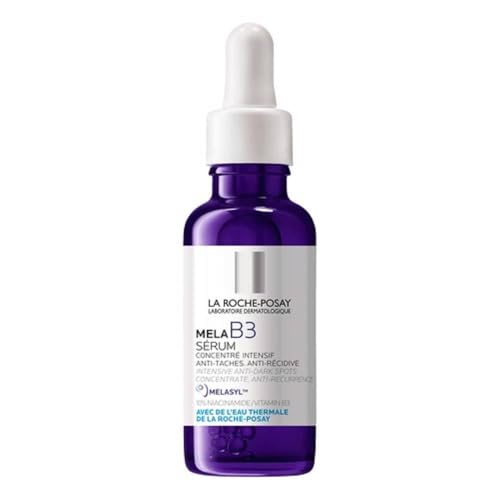
5. La Roche-Posay Mela B3 Dark Spot Face Serum — Best premium
The pick when you want a niacinamide serum built specifically around dark spots, with a dermatological pedigree behind the formula.
Best for: stubborn discoloration where a patented dark-spot complex is worth the outlay Skip it if: your marks are mild and you have not tried a basic 10% niacinamide yet
Mela B3 is the most expensive pick in this comparison and the one built most directly around the search you started with. La Roche-Posay says the pink 1 fl oz serum combines 10% niacinamide with a patented Melasyl complex and is aimed at sun spots, age spots, post-acne marks and post-inflammatory pigmentation. The listing states the formula is born of 18 years of research, is proven on all skin tones, and that 85% of subjects showed significant reduction in persistent dark spots in the brand's testing. Released in 2024, the bottle measures 4.29 x 1.4 x 2.17 in and weighs 1.06 oz.
Its sales rank of 1,302 in serums puts it comfortably ahead of Naturium and the 5% emulsion but well behind The Ordinary. The question the price forces is whether the Melasyl complex is worth several times the outlay of a plain 10% niacinamide. For mild uneven tone the honest answer is probably not, and starting with The Ordinary makes more sense. For long-standing pigmentation that has not responded to a basic niacinamide plus sunscreen, this is the upgrade in the set that pairs the working niacinamide percentage with a formula specifically engineered around the problem.
Pros:
- 10% niacinamide plus patented Melasyl complex, per the listing
- Formulated specifically for dark spots and post-acne marks
- Listing states testing on all skin phototypes
- Dermatologist-backed brand with 18 years of R&D claimed
- Released 2024, so it reflects the current formula
Cons:
- The most expensive pick here
- Only two sellers listed
- 1 fl oz bottle at premium pricing
- Overkill for mild discoloration you have not yet treated with a basic serum
Does niacinamide actually fade dark spots?
Niacinamide has a real, published mechanism for evening skin tone: it interferes with the transfer of pigment from the cells that produce it to the surface skin cells. That is what every serum in this roundup is trading on. It is a supporting ingredient rather than a primary treatment, though. Prescription tyrosinase inhibitors act on the pigment production step itself and work faster. A niacinamide face serum for dark spots is a maintenance and prevention tool, plus a genuine mild fader, and the timelines the brands publish reflect that.
The Ordinary quotes texture improvement in 7 days and pore appearance minimised in 4 weeks. The 5% emulsion claims a more even skin tone in 3 weeks. La Roche-Posay cites 85% of subjects showing significant reduction, without a stated timeframe on the listing snippet. Read those as the fastest realistic outcome, not the average one. If nothing has changed after two months of daily use plus daily sunscreen, the serum is not the missing piece and it is time to see a dermatologist.
How the five formulas stack up on paper
- Niacinamide percentage: Naturium leads at 12%. The Ordinary 10% + Zinc, Anua and La Roche-Posay tie at 10%. The Ordinary emulsion sits at 5%.
- Extra pigment-active ingredients: only Anua (tranexamic acid, arbutin) and La Roche-Posay (Melasyl) go beyond niacinamide plus zinc.
- Bottle size: The Ordinary emulsion at 3.4 fl oz is more than triple everything else. The other four sit at 1 to 1.01 fl oz.
- Price band: The Ordinary 10% and Naturium in entry; the emulsion in mid; Anua and La Roche-Posay in premium.
- Distribution: four listings show two sellers; Anua shows one.
- Release year, where published: Naturium 2019, Anua and The Ordinary 10% + Zinc unstated, emulsion and Mela B3 both 2024.
The one specification worth flagging: only Anua and La Roche-Posay stack a second and third pigment-active ingredient with niacinamide. Everything else is niacinamide plus zinc or niacinamide alone. If your goal is specifically dark spots, that stack matters more than the difference between 10% and 12% niacinamide.
What to layer with your serum
Any niacinamide face serum for dark spots is only half the setup. The other half is what surrounds it in your routine.
- A broad-spectrum sunscreen every morning. Discoloration is largely driven by ultraviolet exposure, and no serum in this roundup can outpace an unprotected face at midday. Skip the sunscreen and none of these picks will do what the listing claims.
- A gentle cleanser. Niacinamide layers under most things, but aggressive foaming cleansers can leave the skin barrier compromised and make any active feel stingier.
- A moisturiser on top. Even the emulsion, which is more emollient than a serum, benefits from a moisturiser to lock hydration in. Apply the serum to slightly damp skin, wait a minute, then moisturise.
- One primary pigment treatment at a time. If you add a vitamin C serum or an exfoliating acid, introduce it separately and space applications across the day. Piling actives triggers irritation, and irritated skin is more prone to post-inflammatory pigmentation, which is the opposite of what you wanted.
Which pick fits which routine?
- Never used niacinamide before: start with The Ordinary Niacinamide 10% + Zinc 1%. Cheapest, most established, easiest to walk away from if your skin flushes.
- Comfortable at 10% and want more push: Naturium at 12% + 2% zinc PCA, still in the entry price band.
- Dark spots on chest, shoulders or upper arms too: the 3.4 fl oz emulsion, because 1 oz is not enough surface area.
- Want one serum to do the whole pigment step: Anua, for the tranexamic acid and arbutin stack, if you accept the single-seller listing.
- Long-standing pigmentation that has not shifted: La Roche-Posay Mela B3, and pair it with daily sunscreen.
The verdict
For most readers searching for the best niacinamide face serum for dark spots, The Ordinary Niacinamide 10% + Zinc 1% is the right default. It delivers the working niacinamide concentration in a 1 fl oz clear serum at the lowest price position in this set, from the brand that anchors the category, and its sales rank of 31 in serums is the plainest signal in the data that this is the product people actually reach for. Start here and see how your skin responds over 4 to 6 weeks.
If your discoloration is stubborn, long-standing, or specifically post-acne or sun-driven, La Roche-Posay Mela B3 is the pick that earns its higher price. It combines the same 10% niacinamide with a patented Melasyl complex and 18 years of stated R&D behind the formula, and its listing is explicitly about dark spots rather than general tone. Two conditions flip the recommendation between them: budget and the severity of the pigmentation. Below moderate discoloration, the winner does everything you need. Above it, and after a sunscreen habit is already in place, the runner-up is worth the outlay.
FAQ
Is a niacinamide face serum for dark spots worth it if I already use vitamin C?
A niacinamide face serum for dark spots earns its slot alongside vitamin C rather than replacing it, because the two act on different steps of pigment formation. Use vitamin C in the morning under sunscreen and niacinamide in the evening, or space them across the day. The Ordinary and Naturium picks are the easiest to add without overloading your routine.
How long does a 1 fl oz niacinamide serum last?
A 1 fl oz niacinamide serum lasts roughly two to three months at twice-daily face application with two to three drops per use. Four of the five picks in this roundup are 1 fl oz or 1.01 fl oz, so plan on repurchasing on that cadence. The Ordinary's 3.4 fl oz emulsion is the exception, and it is sized for face and body use rather than face alone.
The Ordinary 10% vs Naturium 12%: which should I pick?
Between The Ordinary 10% and Naturium 12%, choose The Ordinary if you have never used niacinamide before or your skin flushes easily, and choose Naturium if you have run through a 10% bottle without irritation and want more. Both sit in the entry price band and both come in 1 fl oz sizes. The 2% zinc PCA in Naturium is double The Ordinary's 1%.
Can I use niacinamide with retinol or acids?
Yes, you can use niacinamide with retinol and most acids, and niacinamide often helps buffer the irritation those actives cause. Apply niacinamide first, wait a minute for it to settle, then follow with retinol at night or an acid on alternating evenings. Start once every third night if you are new to layering, and back off any product that stings after two consecutive uses.
What if my dark spots do not fade after three months?
If your dark spots do not fade after three months of consistent niacinamide use plus daily broad-spectrum sunscreen, the serum is not the missing step and a dermatologist visit is the next move. Persistent pigmentation may respond to prescription tyrosinase inhibitors, azelaic acid, or in-office treatments that no over-the-counter serum in this roundup can replicate. Keep using sunscreen while you book the appointment.
The practical move is to pick the entry-level winner, commit to daily sunscreen, and give the serum 6 to 8 weeks of consistent twice-daily use before you judge it. The Ordinary Niacinamide 10% + Zinc 1% is the right default not because it is the strongest formula on paper, but because it lets you learn how niacinamide behaves on your skin without a premium outlay tied to a formula you may not need. If it clears mild uneven tone, you are done. If it plateaus and the spots you want gone are still visible, you have earned the right to spend on the Mela B3 upgrade and you know exactly what you are asking it to do.